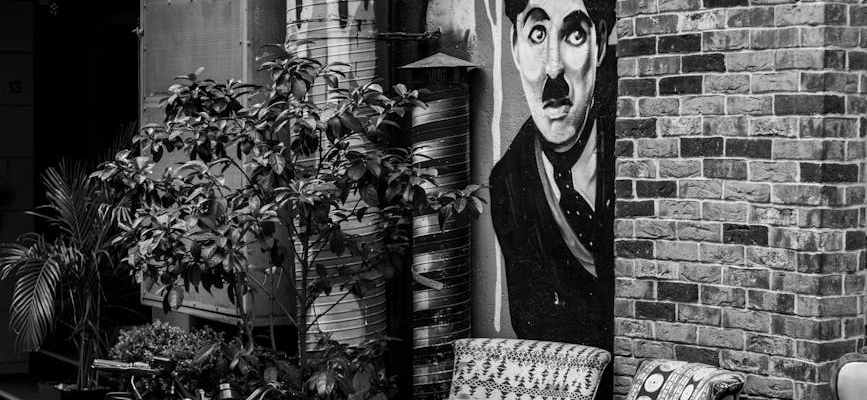
In January 1926, Charlie Chaplin began filming The Circus (1928), which was to be his last silent film as Hollywood transitioned into the “talkies” finish another era of filmmaking but began a new one.
The first Academy Awards was a brief speech followed by dinner, held at The Roosevelt Hotel in the Blossom Room. It wasn’t televised or aired on the radio. Awards had already been announced before the event, and those in the industry were unsure what this would become.
As we head for the big 100, I hope each coming year we can take a deep dive into film, fashion, techniques, and technology that have shaped our industry. We have been handed a great treasure, and my hope is that we can learn from years gone by to shape our storytelling.
These were smart people embracing a new era, the first big movie stars from the famous silent-film star Douglas Fairbanks to the dashing Clark Gable, who had infamous affairs at The Roosevelt. It was an era of a growing middle class, redefining a new world whilst roaring away from the older Victorian Industrial Era. A time when people wanted to feel rich, afford a bit of fashion with a night out on the town, whilst being clued in on all the gossip. A new generation had been born. Let’s dive in, shall we?
Thanks to our new technology, we can enjoy Wings (1927). The silent film won the Best Picture of the Year award.
Douglas Fairbanks
What we would now call a heavy hitter, Fairbanks was indeed crucial to the establishment of Hollywood as an Industry.
Douglas Fairbanks was instrumental in building The Roosevelt Hotel, where the Oscars began. He and Charlie Chaplin were crucial in founding the studio and label United Artists, which remained in production for nearly a hundred years.
As Hollywood’s potential grew, so did its ideas for forming a regulated establishment. There is a reason the industry feels regulated and unionised: it is. That was part of the vision, not some pie-in-the-sky ideal that would fade over time, but an industry that would last, from generation to generation, to watch over and ensure its steadfastness. It is not just about seeing someone’s name in lights; it carries the weight of people’s lives and livelihoods, and the forefathers saw this.
The Dinner and Ceremony
Tickets were available for purchase for guests seeking a luxurious dining experience in the new 1920s style. They enjoyed a soup as the first course, a choice of fish or chicken for the main course, and a dessert of cake and ice cream. Which is pretty much what most big events do today.
The Awards were presented by Douglas Fairbanks, who gave a speech on what people had contributed to their new industry.
Charlie Chaplin
A special lifetime achievement award was also recognised for Charlie Chaplin at the first Oscars.
Chaplin was also a powerhouse in Hollywood, as well as a major silent film star. Los Angeles had become the world’s epicentre of filmmaking. Media as a technology and medium had already taken hold, with newspapers, radio, and lifestyle magazines such as Vogue, Harper’s Bazaar, and Good Housekeeping influencing fashion, entertainment, and home cooking.
The Circus by Charlie Chaplin
Life At Home
The Californian Bungalow had boomed by the 1920s, even being built as far as Australia. A neighbourhood in the city of Adelaide, South Australia, called Colonel Light Gardens, is full of them and is beautifully preserved.
Fairbanks and Chaplin were shrewed business men. They saw the potential that a normal wife was indeed house proud, had access to an electric refrigerator (even though the icebox was still popular into the 1940s), and that a telephone appeared in the home, and that entertainment was available through the radio with shows by radio stars. Fashion, entertainment, and home life were changing.
Of course, the television revolution had not arrived yet, so to enjoy a film, people attended a movie theatre, which had a similar vibe to a theatre presenting a play.
A middle-class society meant pocket money to spend, a nice handbag, a suit or a tie, and modern appliances and furniture. We also get to see the beginning of some help around the home with maids and gardeners offering help to those who wanted the status and an extra hand to look after their family.
In the above video, restored and colourised, we can see the new era emerging. There are cars, public transportation with beautiful trams, and bicycles, in a vibrant Vancouver, British Columbia.
So let’s explore the 1920s, 1930s, and 1940s this year to see what we can find for some inspiration, shall we? Who is up for an adventure?
 Get Your Gorgeous On